SuperDapp — a decentralized super-app
What started as a rebrand of an encrypted communication app grew into a multi-platform super-app with an AI assistant, community monetization tools, and an agent SDK. No clear roadmap, too many stakeholders, tight time to market; and 240k sign-ups in the opening months.
SuperDapp — a decentralized super-app
SuperDapp started as a scope-contained project: rebrand an existing E2E encrypted communication platform (messaging, audio and video calls), a crypto wallet, encrypted file storage, and ship it across web and mobile. Two teams, design and web on one side, iOS and Android native on the other, all reporting to me.
It did not stay scope-contained.
The starting point
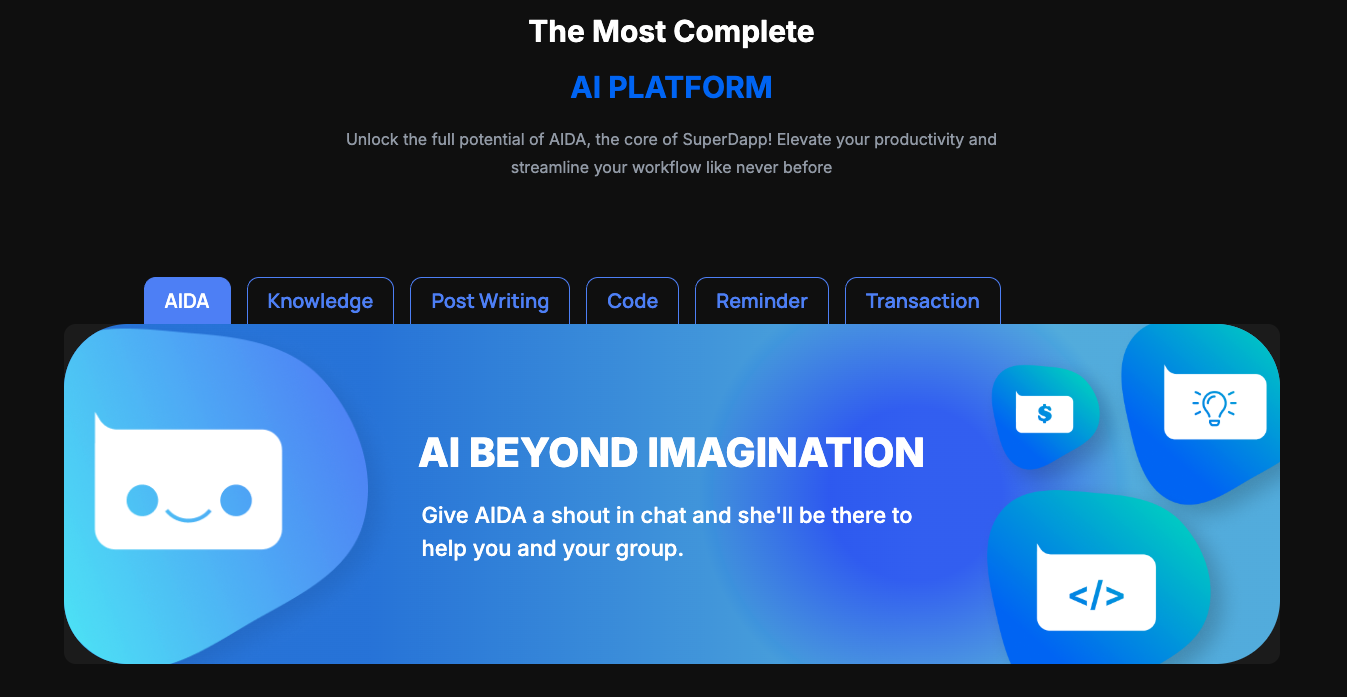
The base platform was not functional: end-to-end encrypted messaging, voice and video, a self-custody multi-chain wallet, and file storage all built in without modern frameworks, legacy tech stack, a LOT of bugs. My initial job was to stabilize the app, lead the rebrand and coordinate the parallel delivery across web and native mobile. Managing two teams working on the same product surface with different tech stacks and different release cycles requires a lot of explicit coordination: shared design systems, clear API contracts, synchronized milestones.
We got the parallel delivery running. Then the roadmap started expanding.
AIDA — the AI assistant
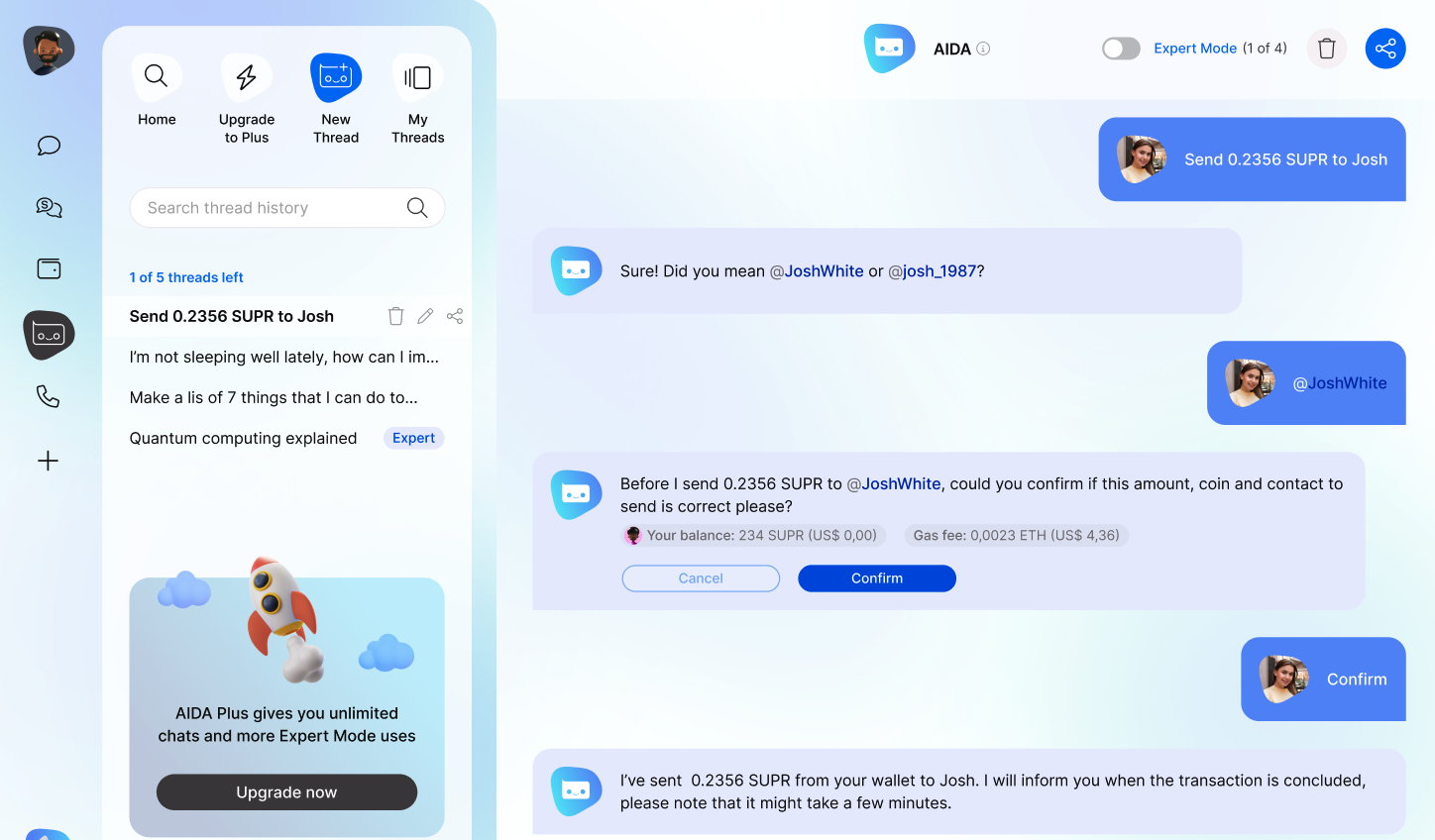
The first major addition was AIDA, an AI assistant built on top of ChatGPT models and integrated directly into the app’s functions.
AIDA wasn’t only a chatbot embedded in a side panel. The idea was that it would serve as a natural language interface to everything the app could do. Send a message to a contact. Make a call. Transfer crypto to someone. Check your wallet balance. All of it accessible through plain language, without navigating menus.
The integration work was significant, AIDA needed to understand the app’s internal state, have access to contacts and wallet data, and be able to trigger actions with real consequences (sending money is not a forgiving surface for errors). We shipped it to production.
Encrypted file storage was dropped during this period, the right call, given what the product was actually becoming.
Super Groups and the agent SDK
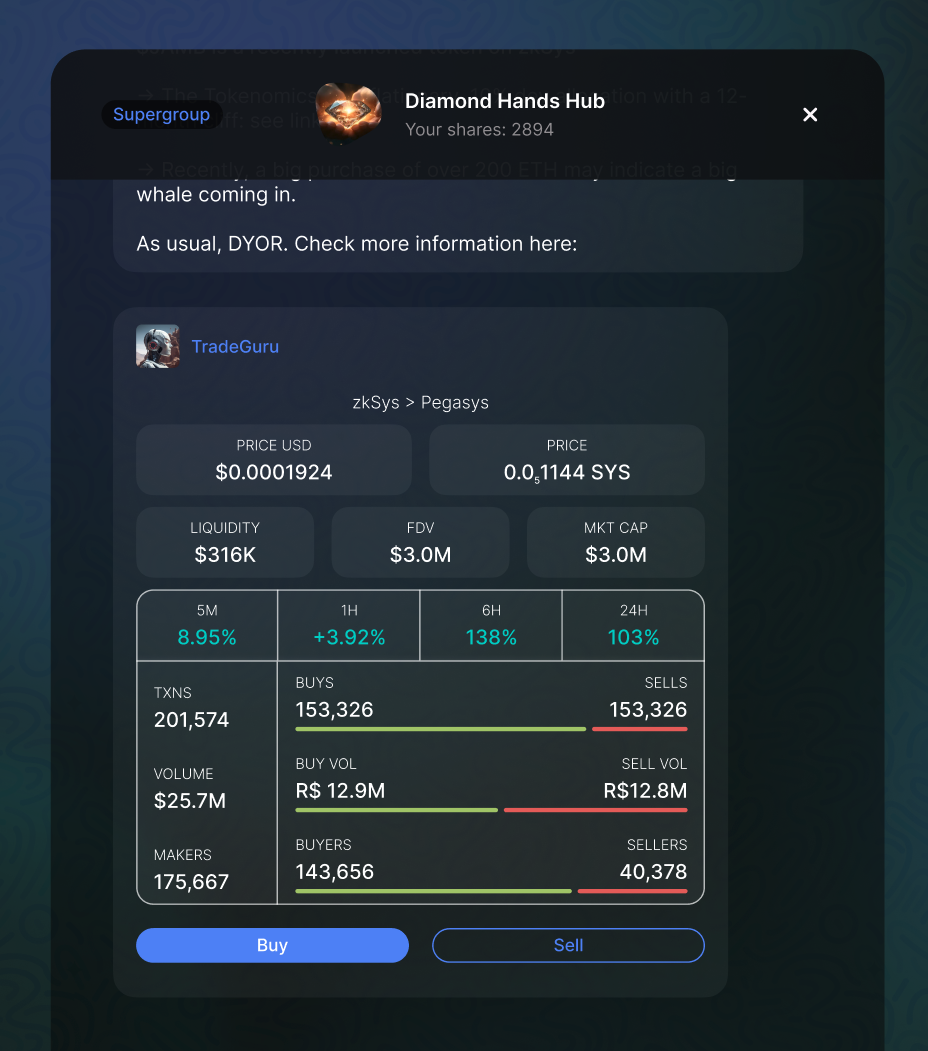
The second major feature was Super Groups — communities that content creators could use to monetize their audiences directly inside the app. Think gated community spaces with crypto-native payment mechanics.
After Super Groups launched, we built superdapp-js, an SDK that let anyone create AI agents and deploy them inside Super Groups communities. This opened the platform to external developers and expanded what the app could be used for well beyond our own roadmap. Over 700 communities were created, and a significant number remained active through the end of the project.
On-ramps and payments
Running parallel to the feature work, I owned the integration of fiat on-ramp partners (Coinify, Banxa, and Changelly) so users could fund their SuperDapp wallets directly with credit cards, debit cards, SWIFT transfers, and bank transfers. This was the full lifecycle: partner selection, commercial negotiation, API integration, and QA through to production.
Getting fiat-to-crypto working reliably is deceptively complex. Each payment method has different fraud profiles, different processing times, different compliance requirements. Getting it right required close coordination with both the external partners and our internal compliance layer.
The shape of the project
SuperDapp was the most complex project I’ve managed in terms of stakeholder count and scope volatility. The roadmap shifted frequently. Priorities were contested. The pressure to ship was constant. Timing to market in the AI + crypto space in 2023–24 was particularly competitive.
What I learned to do was hold a stable execution environment for the engineering teams even when the direction above was uncertain. That means clear sprint goals, honest scope conversations, and protecting engineers from decisions that hadn’t been made yet while still moving forward. Serving as an “umbrella” from the shitstorm from the countless meeting I was in.
The mobile applications were eventually deprioritized as the focus shifted more toward AI and the SDK ecosystem. That transition required its own change management, mobile engineers who’d been heads-down building native apps needed a new direction and, in some cases, new roles.
Outcomes
- 0 → 240k sign-ups in the initial months of launch
- 700+ communities created via Super Groups; many still active
- AIDA shipped to production, LLM-powered assistant with real in-app action capabilities
superdapp-jsSDK deployed across communities, enabling third-party agent development- Fiat on-ramps live: Coinify + Banxa + Changelly covering credit/debit, SWIFT, and bank transfers
What I learned
Scope growth isn’t inherently a failure. It can be a sign that a product is finding real traction. What makes it manageable or destructive is whether you have the organizational infrastructure to absorb the new surface area. When the team has a clear operating rhythm and engineers know how decisions get made, expanding scope is a problem you can solve. Without that foundation, it’s chaos.
Too many stakeholders with competing priorities is one of the hardest environments to work in. The answer isn’t to remove stakeholders, but to be explicit about who owns what decision, and to document trade-offs visibly so that everyone is choosing with the same information.
And shipping an AI assistant in 2023 that actually does things was technically and product-wise much harder than it looked. The failure modes are subtle, the user expectations are high, and the line between impressive and unreliable is thin. We shipped it. That mattered.
For quite some time it remained relevant and useful for our userbase. With time, however, competing directly with other assistants from larger corporations became unsustainable, a learning on its own.